
A NAVIGATOR THROUGH THE WORLD OF CHARITY
The meaning behind the project and the path that led to it.
The desire to help people, society, or the world can take thousands of forms. For some, it means supporting children; for others, caring for animals; for others still, taking part in environmental initiatives, educational programs, medical projects, or helping those going through difficult life situations. But the wider this field of opportunities becomes, the more often the same question arises: where to look, whom to trust, and where to begin.
The problem is not a lack of options. The problem is that there are too many of them, and they are not gathered into a clear system. A person sees individual examples but not the whole picture. They encounter separate initiatives but do not understand how they relate to one another or where their own place fits within this landscape.
This is exactly where the need arises not for yet another list of projects, but for a navigator. Not a tool that makes the choice for a person, but a space where that choice becomes possible. Charity Guide was created as an attempt to bring scattered directions together into a single logical system, so that a person can see more than isolated fragments and approach their decision more calmly and consciously.

When a person sees only one option, it is not a choice.
When they see many unconnected options, it is chaos.
Navigation begins the moment structure appears.
Not to limit.
But to make it possible to see.
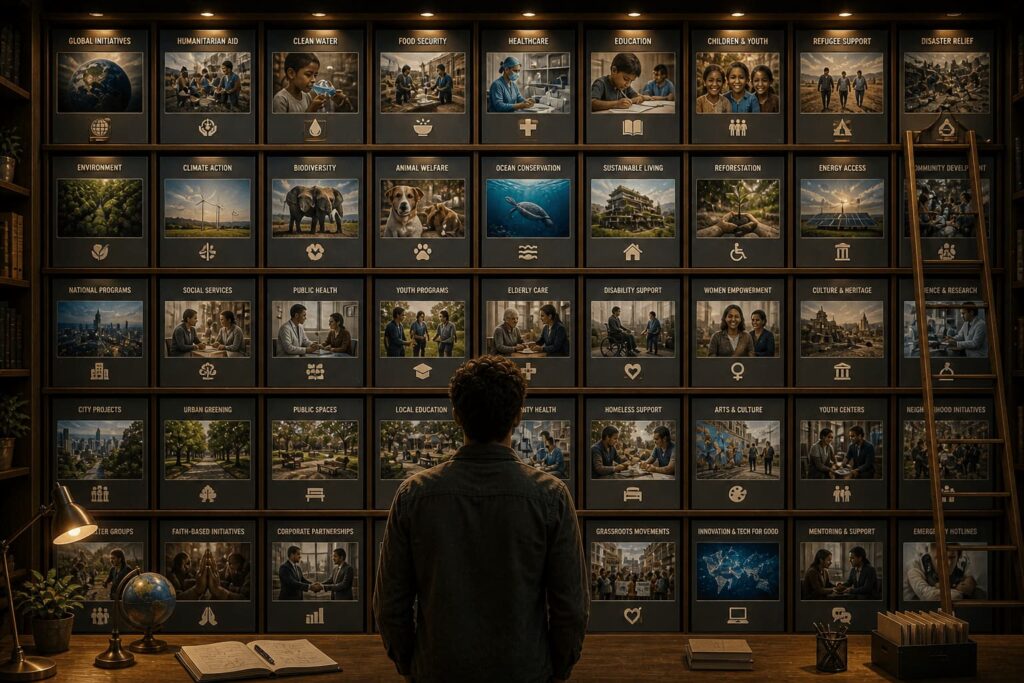
The world of charity and social initiatives is multilayered. It is not limited to one format or one level of participation. Projects of different scale, character, and depth of impact exist side by side here.
International initiatives unite the efforts of different countries and aim to address large humanitarian challenges. These are projects focused on providing people with clean water, fighting hunger, developing medicine, supplying equipment, recovering from natural disasters and military crises, protecting children, supporting refugees, running environmental programs, and preserving human dignity wherever it is under threat. Such initiatives shape the global picture of aid and often work with consequences that affect millions of people.
National projects operate within a specific country and have a deeper sense of its internal needs. This may include supporting low-income families, developing medical programs, helping hospitals, treating children and adults, educational initiatives, employment programs, support for older people, social integration, the development of culture, sport and science, animal protection, and the restoration of infrastructure. These projects strengthen society from within and address needs that are not always visible on a global level.
Urban and local initiatives are even closer to people. This means improving streets and parks, planting trees, supporting schools and children’s institutions, helping local hospitals, cultural events, neighborhood communities, assisting lonely people, environmental campaigns, developing accessible environments, and restoring public spaces. It is here that a person can most often see the result with their own eyes and feel a direct connection between action and change.
And there is one more layer that is hard to describe through categories and scales. These are initiatives connected with attention, participation, and humanity. Supporting people during difficult periods, mentoring, helping those who find themselves alone, and creating a sense of being needed and respected. Sometimes such actions have the strongest impact, even though they cannot be measured by conventional indicators.
It is important to understand: none of these levels is more or less significant than the others. They exist simultaneously and complement one another. Kindness appears both in global decisions and in local deeds.
There is no “right scale” for helping.
There is only the level that is closest to you at the moment.
Sometimes the path begins small.
Sometimes it begins with systemic participation.
Both options are equal if action stands behind them.
A navigator through the world of charity is not only about searching for projects. It is about the inner process a person goes through when facing a choice.
Sometimes the decision comes at once, through emotion or a strong response. Sometimes it takes shape gradually, passing through doubt, comparison, observation, and inner dialogue. And there is no right or wrong scenario in this.
Charity Guide creates a space where this process can unfold more calmly. Here you can see different directions, compare them, understand the scale and character of the activities, and only then make your own decision.
We do not make the choice for you, and we do not offer ready-made answers. We gather information, structure it, and show how diverse the path of helping can be. You may find an initiative that resonates with you right now. You may be inspired by an example and, over time, create something of your own. Or you may simply remember what you saw and return to it later.
What matters already is that a person gets the opportunity to see more.
Perhaps we will never know exactly what decision you made. Perhaps your action will take place far beyond this platform. But if at some point the world has more help, attention, and humanity – then this tool has proved useful. And then the path has been found.
(c) Charity Guide platform (2026)