
The charity sector is built on one of the strongest human emotions – trust.
It is trust that makes people help strangers, transfer money, take part in fundraisers, support initiatives, and share their resources, time, and attention.
But wherever trust exists, there will always be those who try to use it for their own benefit.
That is why fraud in the charity sector is not a new problem of the modern world. It has always existed. Only the tools, scale, and speed of spreading information have changed.
Today, abuse can take many different forms:
- fake fundraisers;
- fabricated stories;
- manipulative photos;
- non-existent foundations;
- copying well-known organizations;
- emotional pressure;
- opaque use of funds;
- fictitious projects;
- artificially created social media pages;
- exploitation of high-profile tragedies and crises.
That is why modern people increasingly need to learn not only to empathize, but also to analyze.
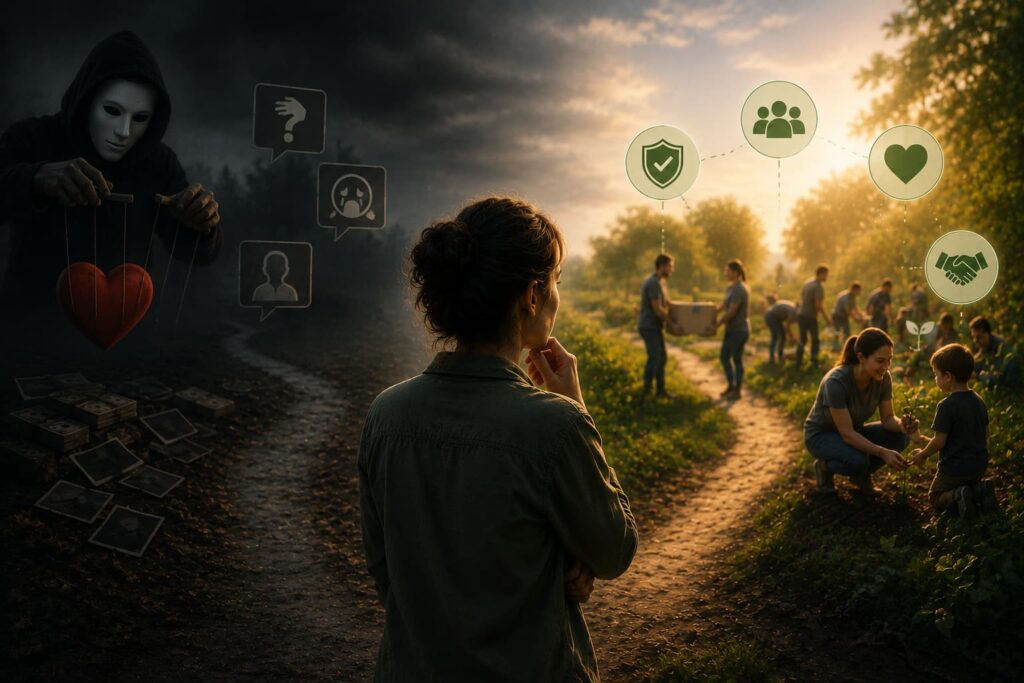
The main problem with charity fraud is not just lost money.
The most dangerous consequence – the erosion of trust.
After high-profile scams, people start doubting not a specific fundraiser, but the very idea of helping. They become more cautious, more guarded, and sometimes walk past even where help is truly needed.
That is why a conscious approach matters not only for protecting the individual. It also matters for preserving trust in those who genuinely do real work.
The modern world creates both new risks and new opportunities for verifying information.
On the one hand, the internet makes it possible to create a page, an emotional story, and a visually convincing fundraiser in just a few minutes.
On the other hand, it is precisely open data, digital footprints, and public activity that help a person see more context.
When taking a more conscious approach, people usually pay attention to the following:
- whether there is a history of activity;
- whether there is an official website;
- whether contact details are provided;
- whether registration information is available;
- whether reports are published;
- whether activity is updated regularly;
- whether there are real projects;
- whether the organization is mentioned in other sources;
- whether there are partners;
- how consistent the information looks;
- whether there are signs of artificially created activity.
At the same time, it is important to understand: the absence of perfect public visibility does not yet mean fraud. This is especially true for small local initiatives or volunteer movements.
But the more transparency, consistency, and real traces of activity a person sees, the calmer and more conscious their choice becomes.

Being conscious is not cynicism.
Verifying information does not make a person less kind.
Questions do not destroy compassion.
Analysis does not cancel the desire to help.
On the contrary.
The modern world is gradually teaching us to combine human compassion with attentiveness, responsibility, and an understanding of who exactly we entrust our resources, emotions, and involvement to.
And perhaps this very form of trust is becoming one of the most sustainable today.
It is probably impossible to completely eliminate fraud from the social sector. As long as crises, emotions, and human vulnerability exist, there will always be those who try to use them for their own benefit.
But society is gradually developing a counter-process.
People are beginning to treat information more carefully.
Organizations increasingly publish reports and show real results.
Open data platforms are developing.
A culture of transparency and digital footprints is emerging.
And all of this is gradually changing the very approach to trust.
Without turning help into cold calculation.
But helping a person remain open to the world – and at the same time a little more protected within it.
(c) Charity Guide platform (2026)