One of the most well-known directions was the fight against the advance of the Gobi Desert. To achieve this, protective shelterbelts were created, soils were reinforced, land-use methods were changed, and long-term programs were launched to restore degraded land. The task was not only about planting trees, but also about changing the ecological resilience of entire regions.
It is important to understand that projects like these do not produce instant results. A young forest needs years to become a fully functioning ecosystem. That is why the key factor of success was not a one-time campaign, but the ability to keep working for decades, despite the complexity, cost and scale of the tasks.
China has also actively used modern technology: satellite monitoring, soil analysis, climate models and systems for tracking the survival of plantings. This made it possible to move from symbolic campaigns to more precise and effective environmental work.
At the same time, experts point to an important nuance: not every planting automatically means a healthy forest. There is growing talk worldwide about biodiversity quality, choosing the right tree species, and the need to create sustainable natural systems rather than simply increasing statistics. This perspective makes environmental programs stronger and more mature.
Even so, the overall conclusion remains significant: when the state, science and society move in the same direction, change becomes measurable. Where land degradation once spread, green zones are gradually appearing, the vulnerability of territories is decreasing, and a different horizon for the future is taking shape.
The history of China’s afforestation matters not because it is perfect. It matters because it shows a rare thing: problems of planetary scale can not only be discussed, but also solved systematically. And sometimes a single planted tree becomes part of changes that will outlast entire generations.
And one more thing:
In recent years, researchers have also been paying attention to the other side of such programs. In some regions, large-scale expansion of forest areas has led to increased water consumption: trees actively draw water from the soil and intensify evapotranspiration. This has added pressure on local water resources, especially in arid zones. This conclusion does not diminish the value of the project, but it serves as a reminder of an important principle of modern ecology: nature needs not only big solutions, but also a precise balance between forests, climate, soil and water.
(c) Charity Guide platform (2026)

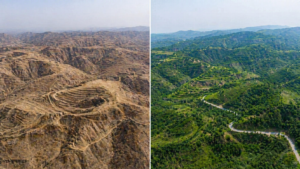 Over the past decades, billions of trees have been planted in China.