
Most charitable and social projects do not begin with large offices, grants, or complex structures.
More often, everything starts with a simple feeling that a problem exists nearby, one that is hard to walk past without caring.
Sometimes it is a broken playground near home. Sometimes it is a shortage of equipment in a hospital. Sometimes it is elderly people who are lonely. Sometimes it is litter in a forest, a lack of cultural spaces, animal welfare issues, ecology, education, social isolation, or help for people who find themselves in a crisis.
At the first stage, it is especially important to understand one simple thing: a charity project does not have to become huge right away.
Many strong initiatives began with a small action:
- a few people;
- one idea;
- a local task;
- personal experience;
- the desire to change something around you.
That is why a project almost always starts not with scale, but with understanding the problem and being ready to take the first step.

One of the main mistakes at the start is trying to “save the whole world” at once.
The modern social sector shows the opposite: sustainable projects are more often born where a person clearly understands a specific problem, the people nearby, and the real opportunities.
Sometimes one courtyard matters more than an abstract “changing the world.”
Sometimes one school matters more than global slogans.
Sometimes one family, one park, one neighborhood, or one local initiative becomes the beginning of something much bigger.
Because big changes almost always begin with clear and real actions.
At the start of a charity project, several basic stages are especially important.
Understanding the problem.
It is important not only to react emotionally to the situation, but also to figure out:
- who exactly needs help;
- why the problem arose;
- what already exists in this area;
- what is really lacking;
- which solutions already work elsewhere.
Understanding the goal.
The more precisely the goal is defined, the easier it is to build the project further. For example:
- collecting equipment;
- running an educational program;
- creating a space;
- helping a specific group of people;
- uniting volunteers;
- changing a specific part of the urban environment.
Understanding the scale.
A project can be:
- local;
- citywide;
- national;
- international.
At the start, it is important not to overestimate your own strength and resources.
Team and partnerships.
Even a small project becomes more sustainable when people willing to take part appear: volunteers, specialists, partners, local communities, businesses, media, or simply those who share the idea.
Transparency and trust.
Modern projects are increasingly built on openness:
- a clear description of goals;
- information about actions;
- publication of results;
- honest communication;
- photos, reports, and updates.
Transparency is exactly what helps people see that an idea is truly turning into action.
Gradual development.
Not every project has to become an organization or a foundation right away. Sometimes an initiative remains a small but very important local action for years.
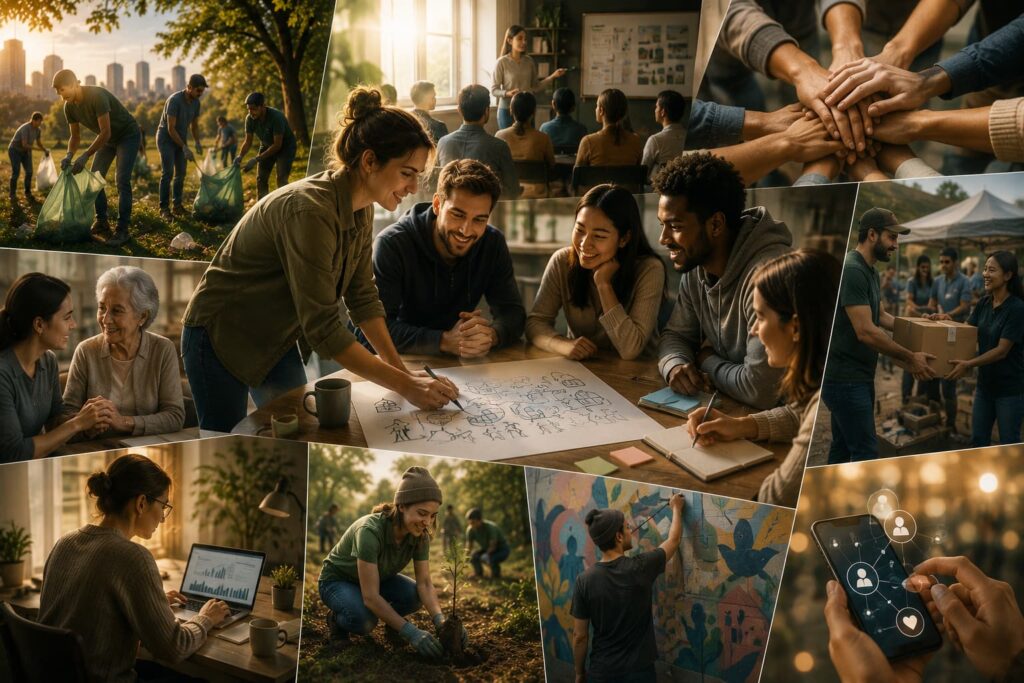
Today a charity project does not necessarily mean just raising money.
It can be:
- uniting people;
- building a community;
- an educational initiative;
- an environmental movement;
- a digital platform;
- a cultural project;
- knowledge sharing;
- skills-based help;
- civic activity;
- informational support;
- a volunteer network.
The modern world gradually shows that a project’s value is determined not only by the size of its budget, but by whether it creates a real movement, participation, and change around it.
Almost every social project has at some point found itself in a place of uncertainty.
Without guarantees.
Without large resources.
Without confidence that everything will work out.
Yet it is often from such starting points that initiatives are born which, after years, begin to change cities, communities, people’s lives, and even the surrounding culture of society.
At the same time, at a certain stage almost every project faces another important question: who will become the bridge between your idea and the social world?
Sometimes this person is the project’s author – if their life path, reputation, experience, and actions inspire trust in people.
Sometimes such a bridge is a company, a team, a community or an already existing organization that helps the initiative take its first steps.