
HOW TRUST IS BUILT
Why transparency, facts and real results matter to people
Trust is rarely built overnight.
It doesn’t appear just because an organization speaks beautifully about its mission. It doesn’t arise automatically after a powerful appeal. It isn’t built on one emotional text, a good logo, a striking photo or a loud promise.
Trust grows gradually.
From openness. From consistency. From clear actions. From facts that can be seen. From results that can be verified. From a willingness to explain, clarify, correct and answer questions.
In the social and charitable sector, trust matters especially. A person who wants to help is almost always at a vulnerable point of choice. They may be ready to give money, time, resources, knowledge, attention or their own experience. But before taking that step, they need to understand: whom they are trusting, why they trust them, and what that trust is based on.
In today’s world, it isn’t enough for people to hear: “We do good.” They want to see what exactly is being done. Where. For whom. For how long. With what resources. With what results. Through which sources this can be confirmed. Can the organization be found in the open space? Does it have a website, social media, reports, publications, contacts, a history of projects, real traces of its activity.
This is not distrust for its own sake. It is a normal need for clarity.
Too many people have encountered fake fundraising, loud promises with no follow-through, beautiful words without action, and situations where emotion was used more than honest information. That is why the question of trust in charity cannot be solved by an appeal to simply “believe us.”
Trust needs a foundation. And that foundation is transparency, facts and real results.
Transparency does not mean an organization must disclose everything without exception or turn every action into a public report. But it does mean a person should be able to see the main reference points: who stands behind the project, what it does, what goals it declares, what actions have already been taken, which sources can be examined, and how to contact its representatives.
Facts don’t replace the human heart, but they help it avoid acting blindly.
Real results are not always measured in big numbers. Sometimes a result is purchased equipment. Sometimes it is a completed program. Sometimes it is a renovated room. Sometimes it is planted trees. Sometimes it is a supported family. Sometimes it is one person who received help in time.
But a result must not only be claimed. It must leave a trace.
That is precisely why Charity Guide speaks about digital footprints, open data and navigation. Not to turn charity into a cold spreadsheet, but to give people more clarity before they choose.
Because trust is not blind faith.
Trust is the willingness to take a step when a person has enough grounds not to walk past.

Trust is born where good intentions stop being just words and begin to be confirmed by open actions.
A person may sympathize right away. But to take part, they often need more than emotion. They need signs of stability, honesty and the reality of what is happening. They want to see not only the problem, but also those who are already working on it. Not only a request, but also a path. Not only a promise, but also the trace of what has been done.
That is why transparency does not weaken good deeds. It makes them stronger. It helps a person understand that their participation can become part of a real process rather than dissolve into the unknown.
Trust matters not only to the person who helps. It also matters to those who create social projects.
A foundation, a volunteer team, a city initiative, a social project or a private individual who starts a good cause often thinks first of the help itself. This is natural. At the center stand a problem, people, animals, a city, nature, a crisis or a specific pain that needs to be answered with action.
But at some point a second level of responsibility appears: if you are doing an important thing, people who might join, support, verify, learn from your experience or carry it forward must be able to find out about it.
Openness is not a decoration on a project. It is part of its sustainability.
When an initiative has a clear description, contacts, a history of actions, photos of results, links to sources, reports, publications or at least regular updates, people more easily understand that they are looking at real activity rather than a random emotional outburst.
This matters especially for small projects.
Large organizations often have a website, a team, reporting, a press service, partners and public mentions. Small initiatives may do no less important work but remain almost invisible. They help in one district, one town, one hospital, one shelter, one school or one group of people. Their activity can be alive and honest, but if it is nowhere reflected, it is hard for an outsider to know how to regard it.
And here the question of trust appears again.
Not every small initiative must immediately look like an international foundation. But it can gradually build its own footprint: showing what has been done, who takes part, what needs exist now, which actions have already taken place, and which contacts are open for communication.
Trust is shaped not by scale, but by consistency.
A small project can inspire trust if it honestly shows its reality. A large organization may raise questions if behind a loud facade it is hard to see specifics. That is why Charity Guide avoids the simple logic of “big means reliable, small means dubious.”
In the social sphere, what matters more is how clear, open and verifiable the activity is.
But trust should not turn into an illusion of absolute guarantee.
Even open data doesn’t provide full protection from error. Even beautiful reports don’t answer all questions. Even a digital footprint doesn’t replace a personal decision. That is why the platform’s task is not to declare whom one can trust unconditionally, but to help a person see more grounds for their own choice.
Charity Guide does not even come close to aspiring to be an authoritative critic of organizations!
The platform aims to be a navigator.
It helps to see different elements: the form of activity, country and city, areas of help, open sources, public traces, current projects, possible contacts, history and context. None of this removes the user’s own responsibility, but it makes their choice more conscious.
Trust is born precisely in this space – between open information and a personal decision.
Where a person is not forced to act blindly.
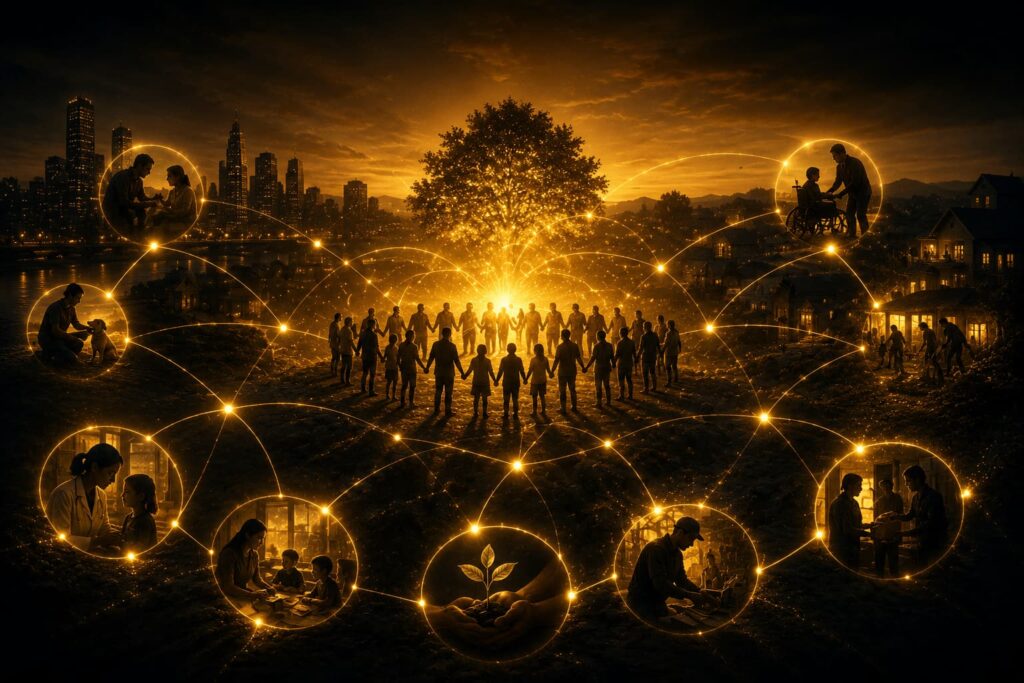
Creative actions change not only individual fates, but also the environment around them.
When people see real results, they begin to perceive the possibility of taking part differently. One project shows that a problem is solvable. One initiative proves that action is possible. One open example lowers the fear of the first step for others.
So kindness stops being merely a personal deed. It becomes a social force. Not because it loudly announces itself, but because it creates new norms: helping is possible, uniting is possible, trusting is possible, acting together is possible.
Kindness is often perceived as a private act.
Someone helped one person. Someone supported one family. Someone bought one piece of equipment. Someone planted a few trees. Someone organized one campaign. Someone made one transfer. Someone passed on one contact. Someone told others about one initiative.
At the level of a single action, all of this may seem small.
But society changes not only through big decisions. It changes through the repetition of creative actions. Through the way what was once exceptional gradually becomes normal. Through the way one example stops being isolated and turns into part of the environment.
If in a city people see that someone looks after a public space, others feel less that everything around is “nobody’s.” If a social project openly shows its results, others find it easier to believe that help can reach its recipient. If volunteers talk about their work respectfully and without self-promotion, someone nearby may for the first time think: “I can be useful too.”
This gives rise not only to trust in a particular organization.
It gives rise to trust in the very possibility of good.
This matters more than it seems.
Because a society in which people believe in no one and nothing gradually loses its capacity for joint action. In it, any initiative is met with suspicion. Any help seems like a scam. Any story about a good deed provokes irritation. Any invitation to take part meets an inner response: “Nothing will change anyway.”
Such a state is dangerous.
Not because all kind people disappear from it. They do not disappear. But they become scattered, cautious, tired and invisible.
The task of open social platforms is not to replace living human responsibility, but to help it find a form. To help kind actions be noticed. To help information be structured. To help a person see where movement already exists, where results are, where there is an opportunity to join, where there are examples worth attention.
Charity Guide is created precisely within this logic.
The platform cannot guarantee that every user will necessarily find their path. It cannot promise that any organization will be perfect. It cannot replace personal verification, local rules, legal procedures, government structures or professional advice.
But it can do something else.
Collect open data. Show digital footprints. Structure information. Tell about projects. Provide space for different forms of participation. Show how kindness works in different countries and communities. Help a person not get lost before the first step.
Trust does not come from a single source. It is formed from many elements: transparency, experience, facts, results, examples, openness, caution and time.
But when it appears, it changes not only the attitude toward a particular project. The environment changes.
People begin to see not only problems, but also actions. Not only risks, but also opportunities. Not only someone else’s responsibility, but also their own place in the common chain.
And then kindness stops being a random gesture.
It becomes a force of society.
© Charity Guide platform (2026)